
Global E-commerce & Connected Experiences
Overview
Fisher & Paykel is a global luxury appliance brand. Its digital ecosystem needs to support different regions, languages, product offers, promotional models and fulfilment requirements while maintaining a consistent premium experience.
Working mainly across the New Zealand and Australian e-commerce platforms, I led and supported improvements across promotions, wishlists, product configuration and cart. I also delivered Connected Home and brand content for Fisher & Paykel and Haier, adapting shared structures for different brands and markets, including China and Singapore.
My role extended beyond interface design. I used customer and performance data to guide decisions, aligned stakeholders across a complex organisation and worked closely with engineering to take solutions through to delivery.
My contribution
The team
Digital, UX, Brand and Marketing
Year
2024–2025
Process
Working across a complex digital ecosystem
I joined Fisher & Paykel during a period of transition, including a six-month gap in design leadership. This required me to build context quickly, navigate a large organisation independently and understand how decisions moved across different teams.
Many of the UX challenges were connected to wider systems, operational processes and regional business requirements. I worked across product, engineering, brand, promotions, customer experience and regional teams to create shared understanding and keep delivery moving.
The design system was also evolving. I collaborated closely with the brand and marketing teams to refine reusable digital patterns around real business needs while maintaining Fisher & Paykel’s distinctive brand expression.
A dedicated consumer insights and brand performance team gave us access to heatmaps, Google Analytics and SEO insights. I used this evidence alongside customer feedback and business data to identify friction, support design decisions and align teams around opportunities.
1. Leading the promotional UX experience
The problem
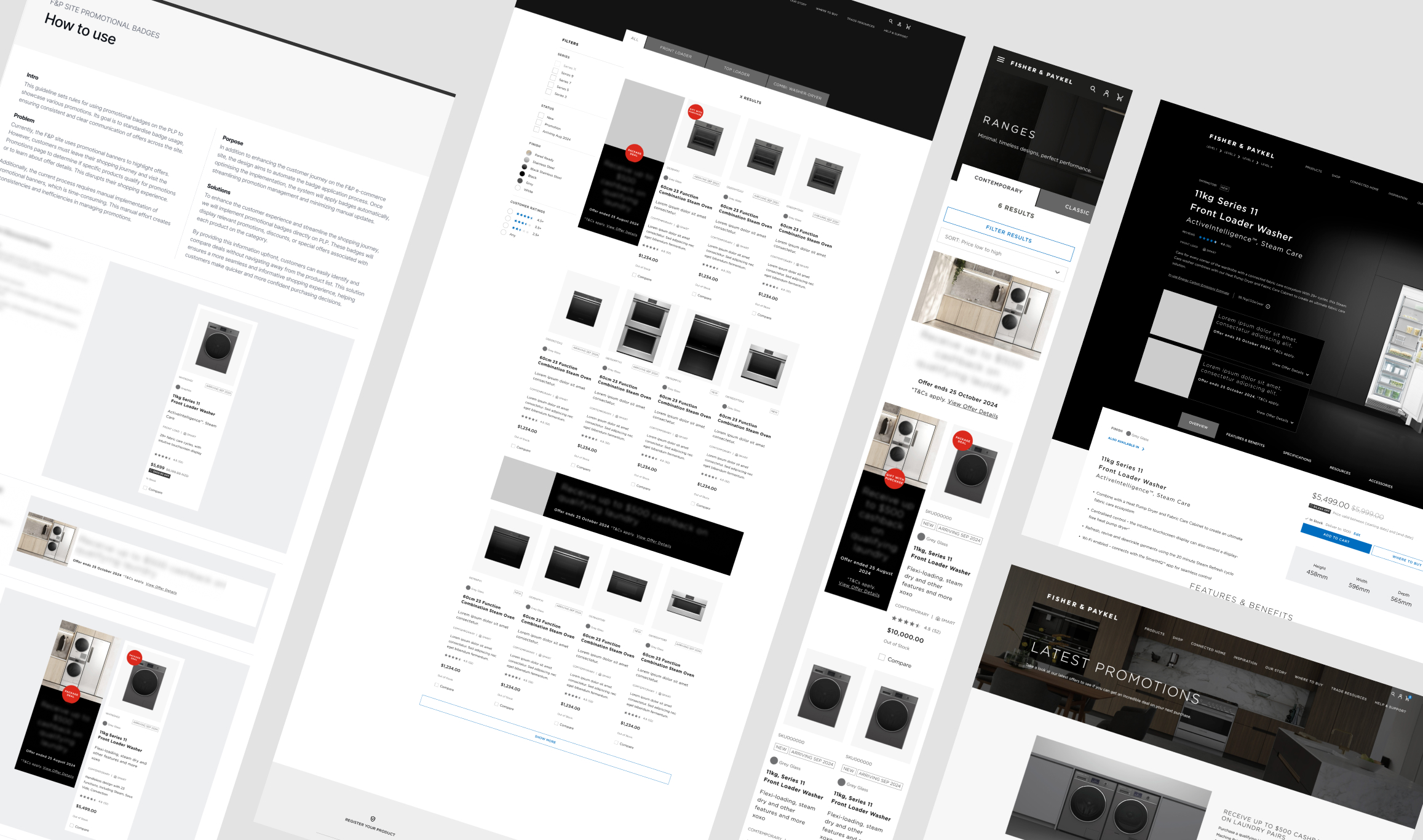
Customers were not always aware of available promotions when discovering products, reviewing product details or checking their cart.
The problem was more complex than adding a promotional banner. Different offers were managed through online discounts, manually handled in-store promotions and case-by-case refunds. The underlying processes were fragmented and not fully integrated.
We needed to make promotions more visible without weakening the premium brand experience, while also supporting the business in moving towards a more consistent and scalable promotional model.
What I did
I led the UX work across the promotional journey from product discovery through to cart.
- Mapped where customers encountered promotional information
- Used analytics and heatmap insights to identify gaps
- Benchmarked premium appliance and luxury e-commerce experiences
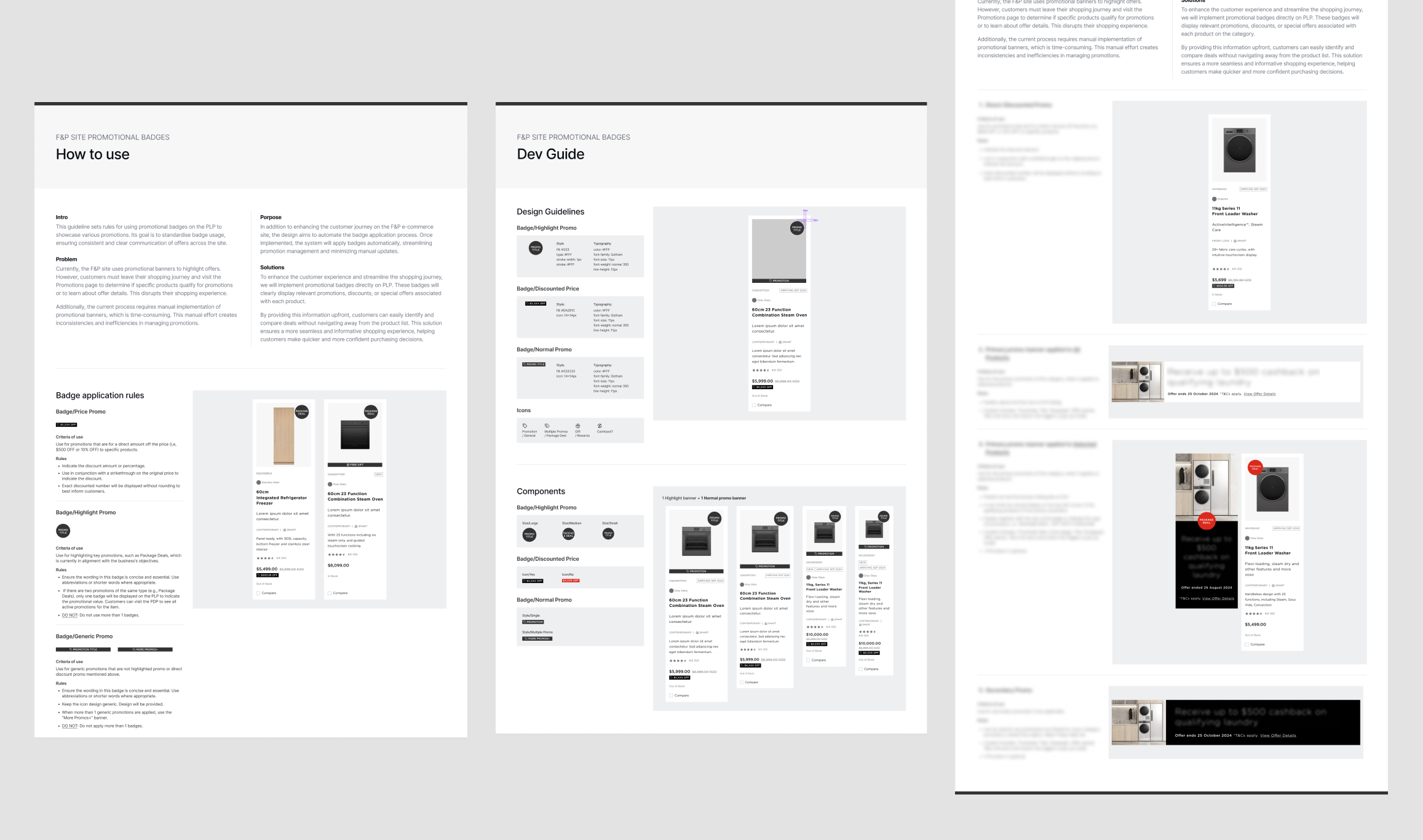
- Defined principles for visibility, eligibility, offer details and consistency
- Refined the cart information hierarchy so customers could better understand the value of their purchase
- Worked with promotions, brand, product, engineering, regional teams and senior stakeholders
- Helped translate fragmented business rules into reusable and technically achievable patterns
The outcome
We created a clearer and more connected promotional journey across key e-commerce touchpoints.
The solution improved the visibility of available offers while giving the business a stronger foundation for a more consistent and automated promotional model.
2. Leading the Wishlist MVP
The problem
Premium appliance purchases often involve a longer decision process. Customers may compare several products, plan purchases across different rooms or return to the website multiple times before deciding.
The platform needed a simple way for customers to save and organise products during this journey.
What I did
I led the UX definition of the Wishlist MVP from early research through to delivery.
- Benchmarked luxury brands and leading e-commerce experiences
- Identified established customer expectations and interaction patterns
- Worked with engineers to understand the platform’s out-of-the-box capabilities and constraints
- Facilitated stakeholder discussions to clarify business requirements
- Defined and prioritised a focused MVP scope
- Designed the core experience for creating, viewing and managing wishlists
- Collaborated with product and engineering throughout implementation
The outcome
We delivered a focused Wishlist MVP that gave customers a clearer way to save and organise products during a considered purchase journey.
The solution worked within the existing platform while creating a foundation for future improvements.
3. Taking an in-progress configurator through delivery
I joined the product configurator project midway through its development and became the sole designer responsible for supporting it through delivery.
The feature allowed customers to configure integrated refrigerators by selecting elements such as the hinge, front panel, handle, joiner kit and toekick.
I quickly absorbed the existing context, reviewed the customer journey and worked closely with product and engineering to resolve UX questions and edge cases. The work also required coordination with customer experience, business development and logistics because product compatibility and fulfilment affected the experience.
My role was not to create the entire product from the beginning. My contribution was to take ownership at a critical stage, protect the quality of the customer experience and identify potential blockers early enough to keep delivery moving.
4. Adapting content across brands and markets
Beyond transactional e-commerce, I also worked on Connected Home, Home Solutions, sustainability and brand-story content.
Fisher & Paykel and Haier shared some underlying structures, but each experience needed to reflect a different brand identity, language, business model and customer context.
One project involved QR-code content placed on appliances to support product registration and app downloads. Some labels needed to work across products sold in China and Singapore. I collaborated with the Haier team to understand how app registration and download journeys operated in China, where digital policies and user behaviour were different from Australasia.
This taught me to look beyond translation and consider how shared platforms must adapt to regional policies, customer expectations and brand differences.
What I took forward
My biggest learning was that design in a large organisation is as much about alignment and execution as it is about interface design.
I learned to understand the systems behind a customer problem, use evidence to create a shared direction and involve engineering and business teams early. I also learned how to influence without formal authority, surface blockers before they affect delivery and protect the customer experience while keeping solutions realistic.
This is now central to how I work: understand the wider system, align people around the problem and remain involved until the experience is delivered.
Outcome
Across my time at Fisher & Paykel, I led the promotional UX experience and Wishlist MVP, helped take a complex product configurator through delivery and supported content across connected-home, regional and multi-brand experiences.
The work created clearer customer journeys, introduced new e-commerce capabilities and helped move the platform towards more reusable patterns and consistent delivery.
Most importantly, the experience developed me into a designer who is comfortable operating independently through ambiguity, translating data and business complexity into product direction, aligning diverse stakeholders and staying close to implementation until the work is shipped.